How to take a real day off
Without losing a single lead, job or payment — even if you've been the system for the last five years.

You don't have a lead problem. You have a handoff problem.
Work isn't the constraint. Everything between the first message and the repeat visit is.
Every question comes to you
The lead's in a DM. The quote's in a doc. The photos are on a tech's phone. Nobody can answer a customer without asking you first.
Four tools that don't talk
CRM, texting app, quote builder, invoicing, reviews. You pay for all of them and you're still the integration between them.
Full bays, thin bank account
Without one record per job, you can't tell if the problem is leads, closing, ticket size or repeat work.
Where the month actually goes
What actually hits the bank today
Quotes answered hours late
Empty bays, no deposit held
Nobody offered while the car was up
Source: model shop — 60 leads/mo · 35% close · $900 avg ticket · industry benchmarks, not a guarantee
You've bought software before. Here's why it slid off.
Repair shop software
Shopmonkey, Tekmetric, Jobber
Made for oil changes and brake jobs. It doesn't know how to quote tint, paint protection, or ceramic coating.
A generic CRM
GoHighLevel, HubSpot, Pipedrive
You have to build everything yourself. It doesn't understand cars, bays, or who installs what.
Texts and a spreadsheet
The way most shops actually run
Fine when it's just you. But once you hire help, only you know what's going on.
Here's the same job when it all lives on one record.
No lead sits overnight
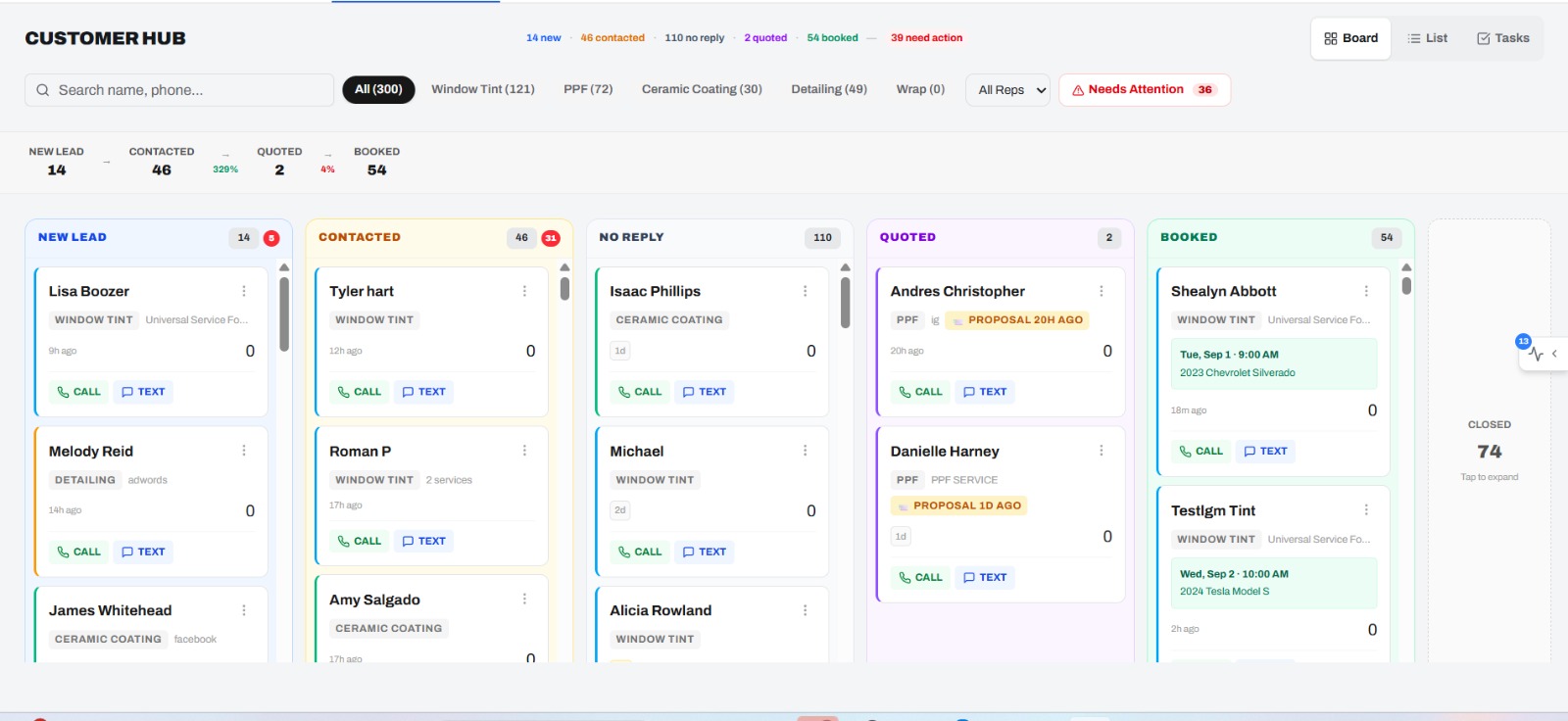
DMs, forms, missed calls and referrals land on one board with the vehicle and the next action attached.

They accept with one tap
No midnight PDF. They tap a link, see the price, hit accept — and you see the second they open it.

"Is it done yet?" stops hitting your cell
Check-in, prep photos and progress updates post to the job and go out to the customer on their own.

The upsell happens without you
The offer is built from the car in the bay, with photos of that vehicle — and the tech gets credit for it.

You stop chasing money
Deposits up front, balance links on completion, one ledger that syncs to your books.

Repeat work stops depending on your memory
Reviews, referrals, maintenance reminders and win-back run as one sequence.

“My team won't use it.” They won't — unless it pays them.
Journey Hub tracks upgrades flagged and photos attached by name. Spiffs become a number you both can see, so using the system is how they get paid more.
Installer
The car in front of them
Check in, drop photos, flag an upgrade — tracked to their name.
Setter / front desk
Today's leads and replies
One inbox, one next action per lead. Nothing lives on a personal phone.
Service advisor
Open jobs and money owed
Send the proposal, take the deposit, push the balance link.
Owner
The whole shop, scored
Leads, close rate, ticket size, repeat work — with the constraint named.
That's the spine. It's about a third of the app.
The rest runs the parts your customer never sees. We walk through it live on the call.
Front of shop
Capture every lead, quote it, and follow up before it goes cold.
Shop floor
Run jobs quote to completion — including mid-service upgrades with photos of the car in your bay.
Back office
Money, payroll, and books tied to the same job record.
Marketing & retention
Know which ad paid for itself and follow up until they refer.
Team & operations
Morning Huddle, tech-level upgrade credit for spiffs, and a health score that names this week's constraint.
What is this costing you?
Put your own numbers in.
Recovered Revenue
Input your shop metrics to see the Journey Hub impact.
Source: your inputs above · straight-line accrual, no compounding · illustrative, not a guarantee
$166,763 / yr · +14.7% on booked revenue
Or walk through it on a demoIllustration, not a forecast · No credit card
Four tools and a group chat, or one job record.
Same car. Two ways to run it.
One car, scattered across six places.
One record the whole car moves through.
- LeadEvery call, text and form in one inbox
- ProposalTap-to-accept, with read receipts
- In the bayPhotos and upgrades on the live job
- PaymentPaid and reconciled on the same record
- Follow-upReviews and win-backs sent automatically

No logo wall. This is our own shop.
We built it because we needed it. Here's what changed after every job went on one record.
What you'd ask before you gave us your number
Answered the way we'd answer them on the call.
My team won't use it.+
They won't if it only reports on them. Upgrades flagged and photos attached are tracked by name, so a spiff is a number nobody argues about.
We use Jobber / Square / a spreadsheet. Do we rip it out?+
Accounting stays where it is and payments sync to it. Everything else moves into one system so nothing gets re-typed.
How long before it's running in my shop?+
We set it up with you — your services, pricing and lead sources. Most shops take real leads through it in week one.
How is this different from Shopmonkey or GoHighLevel?+
Repair software is built for work orders, not coverage options and coating upgrades. A generic CRM is a blank pipeline you build yourself.
Are there per-text or per-proposal fees?+
No. Unlimited proposals and job records. Messaging is passed through at cost.
What does it cost?+
Flat monthly per location. No cut of revenue, no contract — we quote it on the demo.
You're new. Why should I trust it?+
We run our own styling shop on it. You'll see real numbers from it on the demo.
What happens to my data if I leave?+
It's yours. Export everything any time. Cancel with 30 days' notice, no exit fee.
If Journey Hub doesn't add at least $5,000/month in trackable extra revenue or owner time savings within 120 days of going live, we'll work with you for free until it does.
No fine print. No hidden conditions. If the system isn't paying for itself in four months, we keep working until it is.
Get your evenings back.
Twenty minutes on your actual lead flow. If it won't pay for itself, we'll tell you on the call.
Book Your Demo CallNo credit card · No contract · Cancel anytime